
May 26, 2025
UX Writing
I hate these words
My top 5 most useless words that should be avoided in the design presentation.


"The Penitent Magdalene" by Artemisia Gentileschi

This story began when the client send me the technical task where specified a word sh@t (not a sheet)...
It wasn’t that long ago (just a few years), but I still think about it every time I write an email or prepare a presentation. Am I supposed to double-check every word? Yes.
I’m not a copywriter, but this is my guilty pleasure — to make storytelling when I’m presenting the concept or doing testing with clients/users.
And I can teach you how to make a presentation really powerful. But I can also show you what must be avoided when presenting your design, especially these 5 words and their types... They really make me mad, not because they’re bad, but because 90% of the time they come from LLMs and sound so plastic and cold.
So, what are the words that make me mad?
Delightfully styled.
You exactly know what I’m talking about - the words that highlight your or your project’s delightfulness. Like in fairy tales from Disney. But no, they’re from gpt:
- Streamlined
- Enhancing
- Tailored
- Ensuring
- Seamless
As you can see the LLM gives you this types of words if you not specify the style, context, and the goal. It’s not bad to use, as an example, gpt for your presentation, but it all depends on your ability to define what you want to achieve! This tool works only in the way its ‘owner’ thinks.
What I can recommend instead of using these words?
- Streamlined. Saying you "streamlined" something without showing the before and after is like saying, "I cleaned the room" while shoving everything under the bed.Try instead:1) Reduced steps from 7 to 32) Simplified sign-up by 60%
- Enhancing. “Enhanced the dashboard” could mean literally anything: added charts, fixed spacing, made it pink? Be specific.Try instead:1) What exactly changed?2) How did it impact the user?3) Did retention go up? Did support tickets go down?
- Tailored. “Tailored onboarding for enterprise users.” In most cases, “tailored” means “we added a toggle and changed some copy.”Try instead:1) Built onboarding paths based on user roles2) Created dashboards that adapt to client-specific data3) Configured flows per integration
- Ensuring. We can test, advocate, research, support, but “ensuring” is a stretch. It sounds like you wrote the final word on usability. You didn’t. None of us did. Try instead:1) Validated accessibility through testing with screen readers2) Designed with scalability in mind by using modular components3) Conducted usability tests with 12 participants
- Seamless. You can see the chat with gpt, where it gave me this word when I made a simple request to write some info about a food delivery app: '...and enjoy seamless checkout.' This is overused and vague. What does 'seamless' really mean? It doesn’t tell me anything concrete.
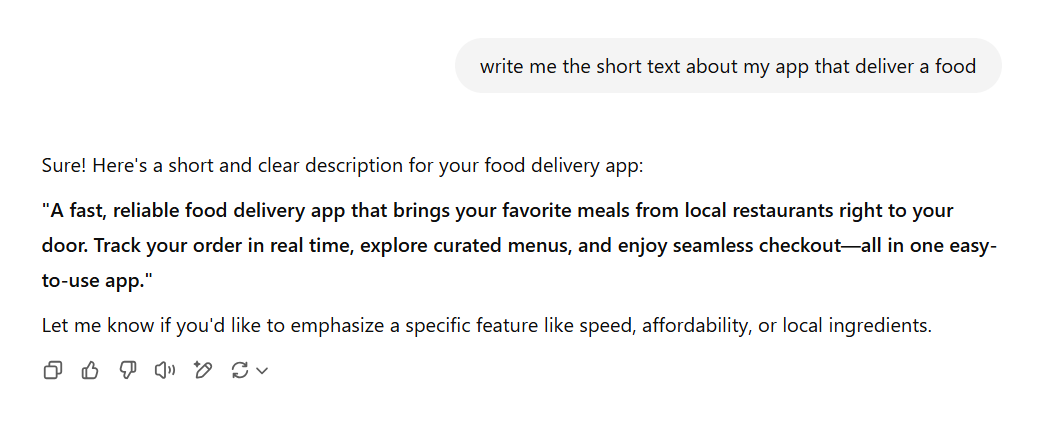
Here’s me chatting with gpt
- Try instead:1) "...and enjoy a quick checkout"2) "...and complete your purchase without any delays."3) "...and finish your order easily in just a few taps."
The Obvious Descriptor
Here also a tricky aspect, because we can talk about obvious things a lot but to forgot highlight the main reason of this speech. Here the quote of President Woodrow Wilson:

If it is a 10-minute speech it takes me all of two weeks to prepare for it; if it is a half-hour speech it takes me a week; if I can talk as long as I want to it requires no preparation at all. I am ready now.
And that makes sense, because creating a 15-minute speech requires even more preparation than a 2-hour one. Those 15 minutes are valuable time for your stakeholders, so you need to capture their interest with your proposal, solution, or concept.
Prepare your text carefully, and avoid using certain types of words:
- "User-friendly interface" (who designs an interface to be user-unfriendly?)
- "Responsive on all devices" (that’s a baseline expectation, not a feature)
- "Simple and clean design" (unless the alternative is messy, don’t say it)
- "Intuitive layout" (instead, show how it’s intuitive by walking through the user path)
Don’t describe what’s already expected. Say what’s different, measurable, or surprising.
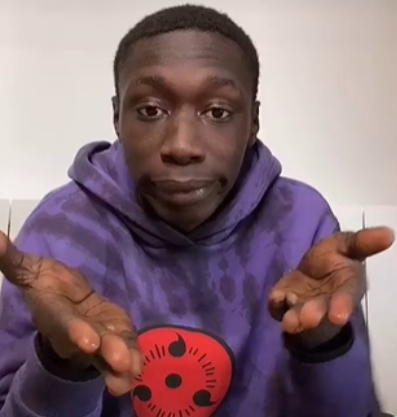
If you’re reading this line, I really appreciate you taking the time to read it. You can subscribe to my Substack to stay updated with my new texts!
Let’s Go!

@ Alina Verzhykivska 2025 | 0.26 CO2 per load
Privacy Policy
May 26, 2025
UX Writing
I hate these words
My top 5 most useless words that should be avoided in the design presentation.

"The Penitent Magdalene" by Artemisia Gentileschi

This story began when the client send me the technical task where specified a word sh@t (not a sheet)...
It wasn’t that long ago (just a few years), but I still think about it every time I write an email or prepare a presentation. Am I supposed to double-check every word? Yes.
I’m not a copywriter, but this is my guilty pleasure — to make storytelling when I’m presenting the concept or doing testing with clients/users.
And I can teach you how to make a presentation really powerful. But I can also show you what must be avoided when presenting your design, especially these 5 words and their types... They really make me mad, not because they’re bad, but because 90% of the time they come from LLMs and sound so plastic and cold.
So, what are the words that make me mad?
Delightfully styled.
You exactly know what I’m talking about - the words that highlight your or your project’s delightfulness. Like in fairy tales from Disney. But no, they’re from gpt:
- Streamlined
- Enhancing
- Tailored
- Ensuring
- Seamless
As you can see the LLM gives you this types of words if you not specify the style, context, and the goal. It’s not bad to use, as an example, gpt for your presentation, but it all depends on your ability to define what you want to achieve! This tool works only in the way its ‘owner’ thinks.
What I can recommend instead of using these words?
- Streamlined. Saying you "streamlined" something without showing the before and after is like saying, "I cleaned the room" while shoving everything under the bed.Try instead:1) Reduced steps from 7 to 32) Simplified sign-up by 60%
- Enhancing. “Enhanced the dashboard” could mean literally anything: added charts, fixed spacing, made it pink? Be specific.Try instead:1) What exactly changed?2) How did it impact the user?3) Did retention go up? Did support tickets go down?
- Tailored. “Tailored onboarding for enterprise users.” In most cases, “tailored” means “we added a toggle and changed some copy.”Try instead:1) Built onboarding paths based on user roles2) Created dashboards that adapt to client-specific data3) Configured flows per integration
- Ensuring. We can test, advocate, research, support, but “ensuring” is a stretch. It sounds like you wrote the final word on usability. You didn’t. None of us did. Try instead:1) Validated accessibility through testing with screen readers2) Designed with scalability in mind by using modular components3) Conducted usability tests with 12 participants
- Seamless. You can see the chat with gpt, where it gave me this word when I made a simple request to write some info about a food delivery app: '...and enjoy seamless checkout.' This is overused and vague. What does 'seamless' really mean? It doesn’t tell me anything concrete.
Here’s me chatting with gpt
- Try instead:1) "...and enjoy a quick checkout"2) "...and complete your purchase without any delays."3) "...and finish your order easily in just a few taps."
The Obvious Descriptor
Here also a tricky aspect, because we can talk about obvious things a lot but to forgot highlight the main reason of this speech. Here the quote of President Woodrow Wilson:

If it is a 10-minute speech it takes me all of two weeks to prepare for it; if it is a half-hour speech it takes me a week; if I can talk as long as I want to it requires no preparation at all. I am ready now.
And that makes sense, because creating a 15-minute speech requires even more preparation than a 2-hour one. Those 15 minutes are valuable time for your stakeholders, so you need to capture their interest with your proposal, solution, or concept.
Prepare your text carefully, and avoid using certain types of words:
- "User-friendly interface" (who designs an interface to be user-unfriendly?)
- "Responsive on all devices" (that’s a baseline expectation, not a feature)
- "Simple and clean design" (unless the alternative is messy, don’t say it)
- "Intuitive layout" (instead, show how it’s intuitive by walking through the user path)
Don’t describe what’s already expected. Say what’s different, measurable, or surprising.
If you’re reading this line, I really appreciate you taking the time to read it. You can subscribe to my Substack to stay updated with my new texts!
Let’s Go!
@ Alina Verzhykivska 2025 | 0.26 CO2 per load
Privacy Policy
May 26, 2025
UX Writing
I hate these words
My top 5 most useless words that should be avoided in the design presentation.

"The Penitent Magdalene" by Artemisia Gentileschi

This story began when the client send me the technical task where specified a word sh@t (not a sheet)...
It wasn’t that long ago (just a few years), but I still think about it every time I write an email or prepare a presentation. Am I supposed to double-check every word? Yes.
I’m not a copywriter, but this is my guilty pleasure — to make storytelling when I’m presenting the concept or doing testing with clients/users.
And I can teach you how to make a presentation really powerful. But I can also show you what must be avoided when presenting your design, especially these 5 words and their types... They really make me mad, not because they’re bad, but because 90% of the time they come from LLMs and sound so plastic and cold.
So, what are the words that make me mad?
Delightfully styled.
You exactly know what I’m talking about - the words that highlight your or your project’s delightfulness. Like in fairy tales from Disney. But no, they’re from gpt:
- Streamlined
- Enhancing
- Tailored
- Ensuring
- Seamless
As you can see the LLM gives you this types of words if you not specify the style, context, and the goal. It’s not bad to use, as an example, gpt for your presentation, but it all depends on your ability to define what you want to achieve! This tool works only in the way its ‘owner’ thinks.
What I can recommend instead of using these words?
- Streamlined. Saying you "streamlined" something without showing the before and after is like saying, "I cleaned the room" while shoving everything under the bed.Try instead:1) Reduced steps from 7 to 32) Simplified sign-up by 60%
- Enhancing. “Enhanced the dashboard” could mean literally anything: added charts, fixed spacing, made it pink? Be specific.Try instead:1) What exactly changed?2) How did it impact the user?3) Did retention go up? Did support tickets go down?
- Tailored. “Tailored onboarding for enterprise users.” In most cases, “tailored” means “we added a toggle and changed some copy.”Try instead:1) Built onboarding paths based on user roles2) Created dashboards that adapt to client-specific data3) Configured flows per integration
- Ensuring. We can test, advocate, research, support, but “ensuring” is a stretch. It sounds like you wrote the final word on usability. You didn’t. None of us did. Try instead:1) Validated accessibility through testing with screen readers2) Designed with scalability in mind by using modular components3) Conducted usability tests with 12 participants
- Seamless. You can see the chat with gpt, where it gave me this word when I made a simple request to write some info about a food delivery app: '...and enjoy seamless checkout.' This is overused and vague. What does 'seamless' really mean? It doesn’t tell me anything concrete.
Here’s me chatting with gpt
- Try instead:1) "...and enjoy a quick checkout"2) "...and complete your purchase without any delays."3) "...and finish your order easily in just a few taps."
The Obvious Descriptor
Here also a tricky aspect, because we can talk about obvious things a lot but to forgot highlight the main reason of this speech. Here the quote of President Woodrow Wilson:

If it is a 10-minute speech it takes me all of two weeks to prepare for it; if it is a half-hour speech it takes me a week; if I can talk as long as I want to it requires no preparation at all. I am ready now.
And that makes sense, because creating a 15-minute speech requires even more preparation than a 2-hour one. Those 15 minutes are valuable time for your stakeholders, so you need to capture their interest with your proposal, solution, or concept.
Prepare your text carefully, and avoid using certain types of words:
- "User-friendly interface" (who designs an interface to be user-unfriendly?)
- "Responsive on all devices" (that’s a baseline expectation, not a feature)
- "Simple and clean design" (unless the alternative is messy, don’t say it)
- "Intuitive layout" (instead, show how it’s intuitive by walking through the user path)
Don’t describe what’s already expected. Say what’s different, measurable, or surprising.
If you’re reading this line, I really appreciate you taking the time to read it. You can subscribe to my Substack to stay updated with my new texts!
Let’s Go!
@ Alina Verzhykivska 2025 | 0.26 CO2 per load